UX Design
MIxed Methods
Sales Industry
From Search to Ask AI
From Search to Ask AI
Company
Proshort
Category:
UX Research
My Role:
Lead Researcher
How broken search behavior triggered a research-led redesign — replacing rigid CRM filters with a conversational decision layer. 30+ sales managers. A mixed-methods trust study. Five design principles.
And a product that reached 27% weekly adoption in 8 weeks with zero onboarding.
30+ Managers
Interview sample
Mixed Research
Method
5 Design Principles
Impact
THE EVOLUTION
Why Global Search as a Feature Needed to Change
Why Global Search as a Feature Needed to Change
Search Was Built for a World Where Users Know What They're Looking For
Global search assumes the user already speaks the system's language — exact field names, object types, filter logic. Sales managers don't. They have business questions that span multiple CRM objects, time pressure before pipeline reviews, and zero tolerance for null results. Search rewarded users who had already learned the data model. That group was small and shrinking as the product scaled.
78% of search sessions ended without the user finding what they needed. The top 10 most-searched terms were phrased as questions, not entity names. Search was used by 23% of active users weekly — Search was failing users.
What the behavioral data showed
Referencing
What search required
Referencing
What search required
Business questions · Time pressure · Cross-object needs
What users actually had
Business questions · Time pressure · Cross-object needs
What users actually had
Users had questions. Search expected queries. That gap was the product.
The gap
Users had questions. Search expected queries. That gap was the product.
The gap
USER FLOW COMPARISON
Search vs Ask AI — Where They Diverge
Same starting point. Completely different journey to the answer.
Same starting point. Completely different journey to the answer.
Both flows begin with the same user state: a business question and no clear path to the answer. They diverge immediately at the first input step, and never converge until the decision — 3.2 minutes apart.
GLOBAL SEARCH FLOW — avg 3.2 min
1
User has a business question
User has a business question
"Who are my top accounts at risk this quarter?"
“Who are my top accounts at risk this quarter?”
2
Opens search bar
Opens search bar
Has to know: which CRM object to search, what fields exist, exact terminology
Has to know: which CRM object to search, what fields exist, exact terminology
3
Gets a list of raw records
Gets a list of raw records
Unranked list of matching records — no context, no interpretation, no answer
Unranked list of matching records — no context, no interpretation, no answer
4
Applies filters, re-queries, narrows manually
Applies filters, re-queries, narrows manually
User does the interpretation work — multiple rounds of refinement
User does the interpretation work — multiple rounds of refinement
5
Opens individual records to cross-reference
Opens individual records to cross-reference
Still no answer — only raw data that must be assembled into meaning
Still no answer — only raw data that must be assembled into meaning
6
Decision made — avg 3.2 minutes
Decision made — avg 3.2 minutes
78% of sessions didn't reach this step at all
78% of sessions didn’t reach this step at all
ASK AI FLOW — avg 38 sec
1
User has the same business question
User has the same business question
"Who are my top accounts at risk this quarter?"
“Who are my top accounts at risk this quarter?”
2
Types the question exactly as they'd say it
Types the question exactly as they’d say it
No translation needed — natural language, no data model knowledge required
No translation needed — natural language, no data model knowledge required
3
AI queries the same data sources as global search
AI queries the same data sources as global search
Same CRM database · Same ACL/permission filter · Same records retrieved
Same CRM database · Same ACL/permission filter · Same records retrieved
4
Returns: structured answer + reasoning + source citations
Returns: structured answer + reasoning + source citations
AI does the interpretation work — user receives meaning, not raw records
AI does the interpretation work — user receives meaning, not raw records
5
Decision made — avg 38 seconds
Decision made — avg 38 seconds
Source citations link Helps user can verify without the search
Source citations link Helps user can verify without the search
Ask AI didn't replace search. It replaced the 5 minutes of work that search used to put between the user and the answer.
THE ARCHITECTURE INSIGHT
Same Data. Same Permissions. Different Interface Contract.
Same Data. Same Permissions. Different Interface Contract.
Ask AI Doesn't Replace Search — It Reframes What Search Gives You
The insight that changed the product direction: Ask AI and global search draw from identical data sources. Same CRM database. Same ACL (access control list) permission filtering. Same record objects. But a global search returns that data as a list—the user builds the answer. Ask AI receives the same list—the AI builds the answer—the user receives meaning plus verifiable source citations. The data layer is shared. The contract with the user is completely different.
The source citations in Ask AI link to the exact records that global search would have returned. The user gets the answer and the proof — without the work.
User types: "Mumbai accounts"
Global Search input
User types: "Mumbai accounts"
Global Search input
User types: "Who are my top accounts in Mumbai this quarter?"
Ask AI input
User types: "Who are my top accounts in Mumbai this quarter?"
Ask AI input
SHARED LAYER ↓
Same database query · Same filter · Same 3 account records returned as source data
List of records → user infers the ranking themselves
Search output
List of records → user infers the ranking themselves
Search output
Ranked answer + reasoning + source links to same 3 records
Ask AI output
Ranked answer + reasoning + source links to same 3 records
Ask AI output

Problem Statement
TRUST QUESTION
When Do Users Trust AI?
AI features were shipping fast, but adoption was uneven. Some sales managers leaned on AI suggestions every day. Others ignored them entirely - even when the suggestions were demonstrably accurate. Engineering kept improving accuracy. The needle didn't move. The question wasn't technical. It was behavioural: what makes an AI suggestion feel trustworthy enough to act on?
"It's probably right, but I want to know why before I send it to my team."
This was the most common sentiment across early interviews. Trust wasn't a binary. It was a function of context, transparency, and the cost of being wrong. We needed to map it.
This was the most common sentiment across early interviews. Trust wasn't a binary. It was a function of context, transparency, and the cost of being wrong.
We needed to map it.
Researsh Methodology
Mix Methods Study
Mix Methods Study
Three Methods, One Question
Interviews surface stated preferences. Behavioural data reveals actual ones. Diary studies bridge the two. Running all three over 12 weeks gave us a triangulated view of what managers say, do, and feel about AI suggestions in their daily workflow.
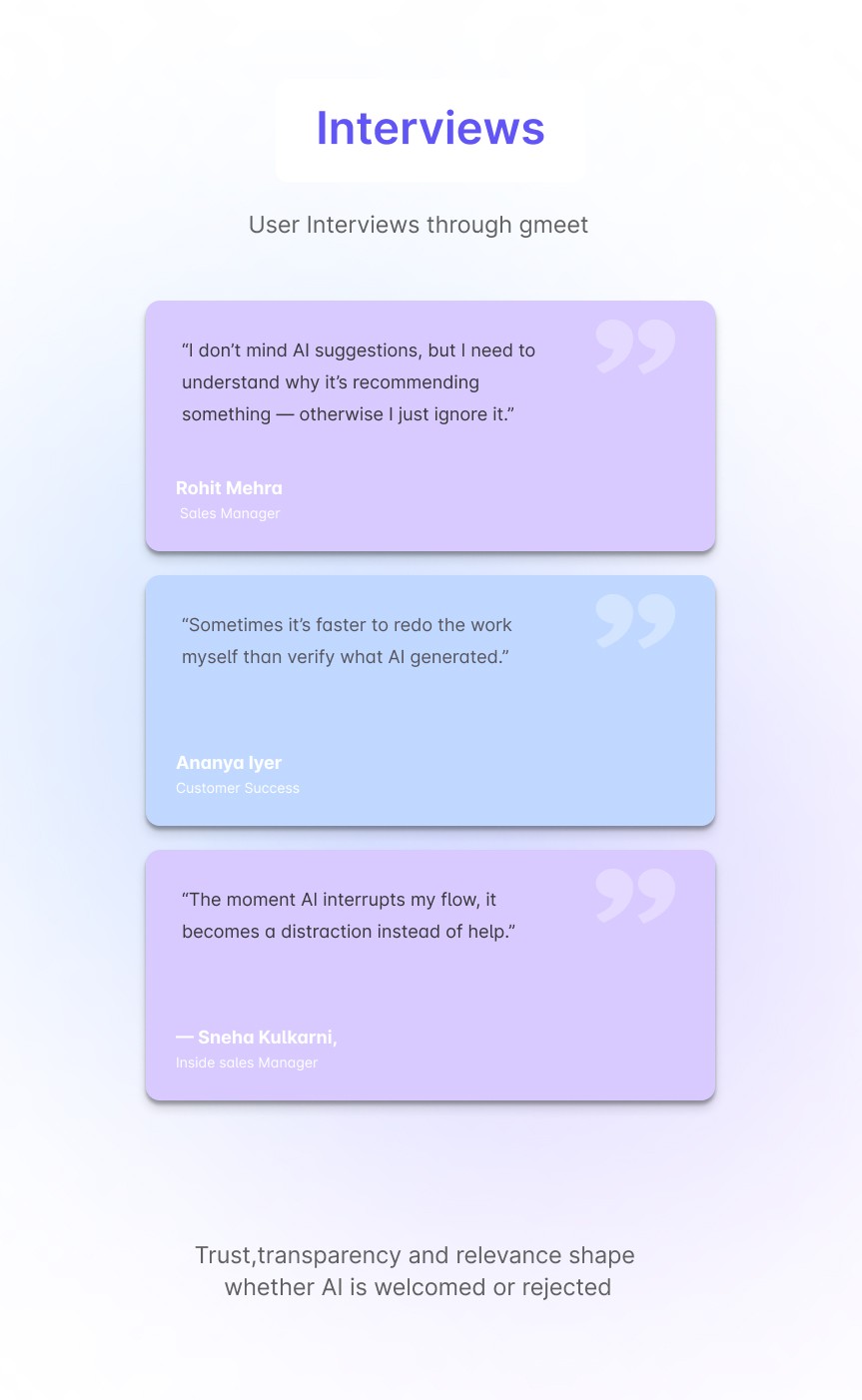
Interviews explained motivation, User survey showed behavior, and diary entries captured in-the-moment trust breakdowns.
Method Matrix
Interviews explained motivation, User survey showed behavior, and diary entries captured in-the-moment trust breakdowns.
Method Matrix
"The Moment ai interupts my flow it becomes a distraction instead of help."
Rob besman
Sales Manager
A
SEMI-STRUCTURED INTERVIEWS
32 managers, 45 minutes each. Open prompts about real AI moments — what they used, ignored, or distrusted, and why.
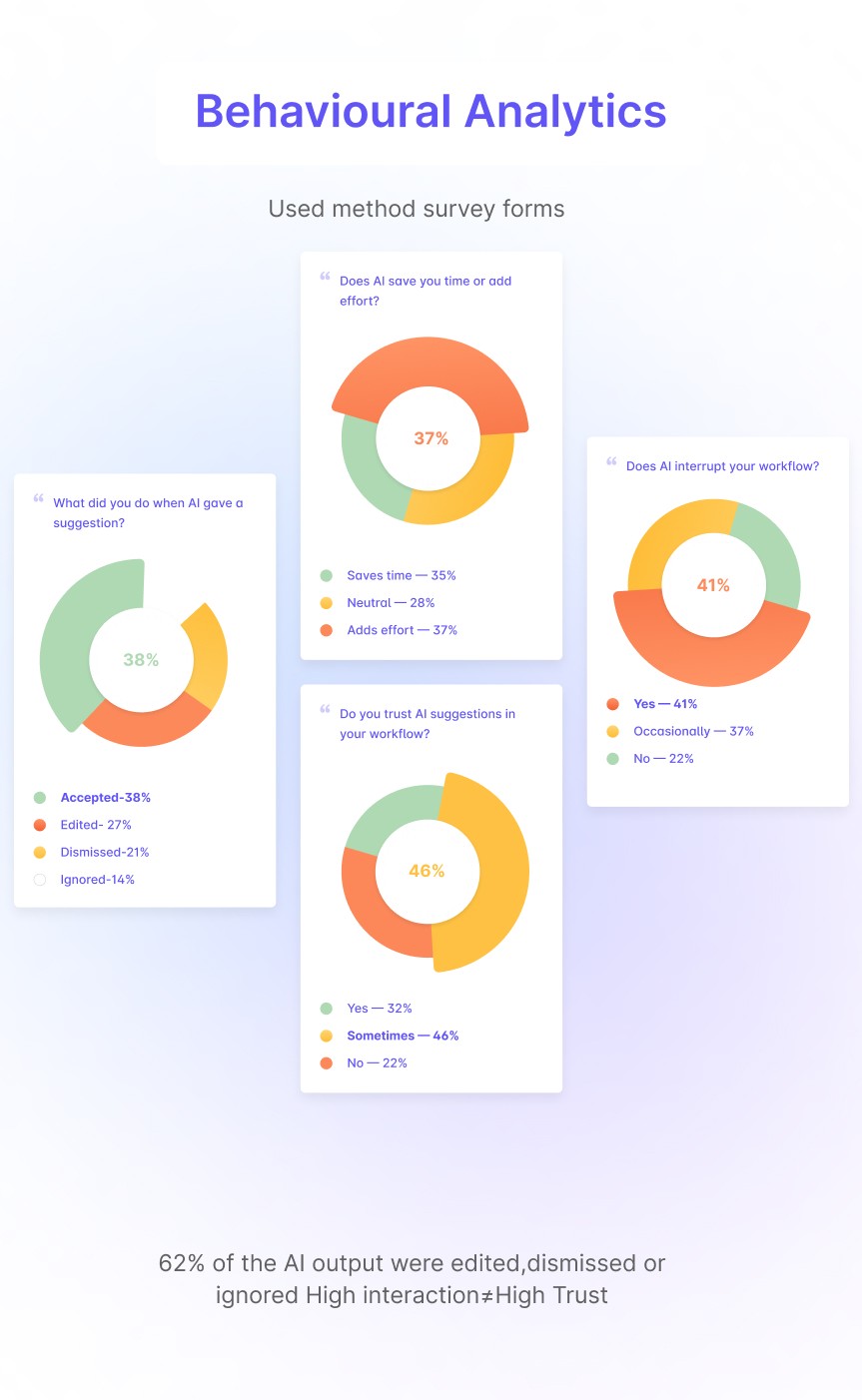
B
BEHAVIOURAL ANALYTICS
Used survey forms across 20+ users tracking which AI surfaces got accepted, edited, dismissed, or ignored. Behaviour vs stated preference.
C
2-WEEK DIARY STUDY
12 managers logged in-context reactions whenever AI surfaced something. Captured emotion at the moment of decision — not in retrospect.

Research results
BEHAVIORAL PATTERNS
BEHAVIORAL PATTERNS
Used Tool: Google Analytics,Usertesting.com,
What the Data Said
After 2 weeks of data and 60+ logged AI interactions, three patterns emerged that shifted how we think about AI UX.
This was the most common sentiment across early interviews. Trust wasn't a binary. It was a function of context, transparency, and the cost of being wrong.
We needed to map it.
73% asked for reasoning even when they trusted the AI was right — the why mattered as much as the what. Suggestions that were editable saw 2.4× the engagement of "final" outputs. And 80% of users who dismissed an AI suggestion early stopped looking at that surface entirely — first impressions are nearly impossible to recover.
Want Reasoning
Even whenn correct
73%
More Likely to use
When editable,not final
2.4X
Dimissed once
Ignored thereafter
8/10
Used Tool: Google Analytics,Usertesting.com, Gmeet. personal interviews
Analysis Results
PRODUCT PRINCIPLES
PRODUCT PRINCIPLES
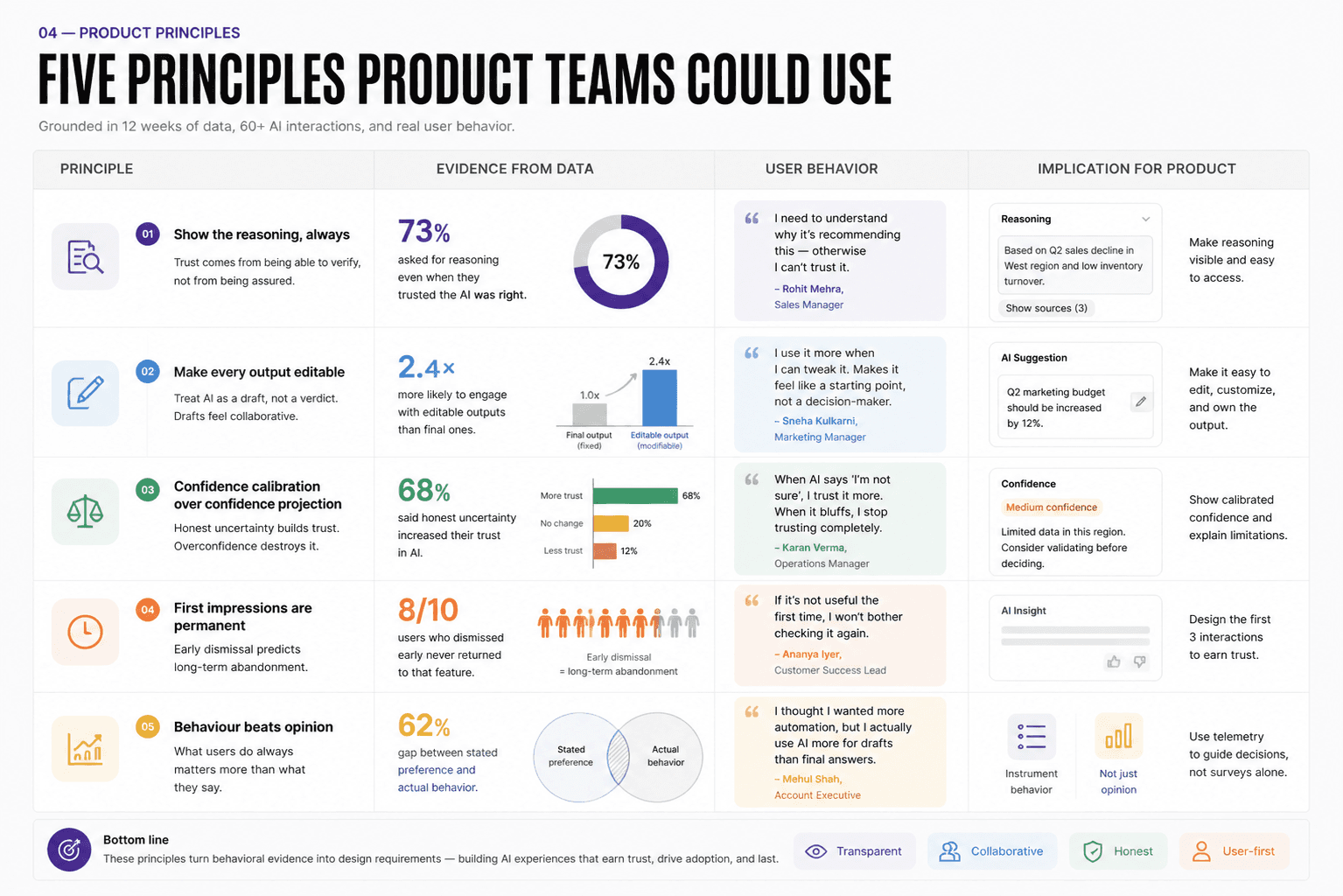
Five Principles Product Teams Could Use
05
Behaviour beats opinion
Stated preference and actual usage diverged in nearly every interview. Always instrument the behaviour. Surveys tell you what users want to believe; telemetry tells you what they actually do.
04
First impressions are permanent
A single early dismissal predicted long-term abandonment of an AI surface. Spend disproportionate effort on the first three interactions of every AI feature.
03
Confidence calibration over confidence projection
When AI was uncertain, saying so increased trust. When it bluffed, trust collapsed permanently. Honest uncertainty is a feature.
02
Make every output editable
Treat AI as a draft, not a verdict. The 2.4× engagement gap was the single biggest behavioural finding. "Final" outputs felt presumptuous; drafts felt collaborative.
01
Show the reasoning, always
Every AI output exposes its source data and decision logic on demand. Trust comes from being able to verify, not from being assured. The reasoning trace became the most-used feature in Ask AI.
Related Projects
UX Design
MIxed Methods
Sales Industry
From Search to Ask AI
From Search to Ask AI
Company
Proshort
Category:
UX Research
My Role:
Lead Researcher
How broken search behavior triggered a research-led redesign — replacing rigid CRM filters with a conversational decision layer. 30+ sales managers. A mixed-methods trust study. Five design principles.
And a product that reached 27% weekly adoption in 8 weeks with zero onboarding.
30+ Managers
Interview sample
Mixed Research
Method
5 Design Principles
Impact
THE EVOLUTION
Why Global Search as a Feature Needed to Change
Why Global Search as a Feature Needed to Change
Search Was Built for a World Where Users Know What They're Looking For
Global search assumes the user already speaks the system's language — exact field names, object types, filter logic. Sales managers don't. They have business questions that span multiple CRM objects, time pressure before pipeline reviews, and zero tolerance for null results. Search rewarded users who had already learned the data model. That group was small and shrinking as the product scaled.
78% of search sessions ended without the user finding what they needed. The top 10 most-searched terms were phrased as questions, not entity names. Search was used by 23% of active users weekly — Search was failing users.
What the behavioral data showed
Referencing
What search required
Referencing
What search required
Business questions · Time pressure · Cross-object needs
What users actually had
Business questions · Time pressure · Cross-object needs
What users actually had
Users had questions. Search expected queries. That gap was the product.
The gap
Users had questions. Search expected queries. That gap was the product.
The gap
USER FLOW COMPARISON
Search vs Ask AI — Where They Diverge
Same starting point. Completely different journey to the answer.
Same starting point. Completely different journey to the answer.
Both flows begin with the same user state: a business question and no clear path to the answer. They diverge immediately at the first input step, and never converge until the decision — 3.2 minutes apart.
GLOBAL SEARCH FLOW — avg 3.2 min
1
User has a business question
User has a business question
"Who are my top accounts at risk this quarter?"
“Who are my top accounts at risk this quarter?”
2
Opens search bar
Opens search bar
Has to know: which CRM object to search, what fields exist, exact terminology
Has to know: which CRM object to search, what fields exist, exact terminology
3
Gets a list of raw records
Gets a list of raw records
Unranked list of matching records — no context, no interpretation, no answer
Unranked list of matching records — no context, no interpretation, no answer
4
Applies filters, re-queries, narrows manually
Applies filters, re-queries, narrows manually
User does the interpretation work — multiple rounds of refinement
User does the interpretation work — multiple rounds of refinement
5
Opens individual records to cross-reference
Opens individual records to cross-reference
Still no answer — only raw data that must be assembled into meaning
Still no answer — only raw data that must be assembled into meaning
6
Decision made — avg 3.2 minutes
Decision made — avg 3.2 minutes
78% of sessions didn't reach this step at all
78% of sessions didn’t reach this step at all
ASK AI FLOW — avg 38 sec
1
User has the same business question
User has the same business question
"Who are my top accounts at risk this quarter?"
“Who are my top accounts at risk this quarter?”
2
Types the question exactly as they'd say it
Types the question exactly as they’d say it
No translation needed — natural language, no data model knowledge required
No translation needed — natural language, no data model knowledge required
3
AI queries the same data sources as global search
AI queries the same data sources as global search
Same CRM database · Same ACL/permission filter · Same records retrieved
Same CRM database · Same ACL/permission filter · Same records retrieved
4
Returns: structured answer + reasoning + source citations
Returns: structured answer + reasoning + source citations
AI does the interpretation work — user receives meaning, not raw records
AI does the interpretation work — user receives meaning, not raw records
5
Decision made — avg 38 seconds
Decision made — avg 38 seconds
Source citations link Helps user can verify without the search
Source citations link Helps user can verify without the search
Ask AI didn't replace search. It replaced the 5 minutes of work that search used to put between the user and the answer.
THE ARCHITECTURE INSIGHT
Same Data. Same Permissions. Different Interface Contract.
Same Data. Same Permissions. Different Interface Contract.
Ask AI Doesn't Replace Search — It Reframes What Search Gives You
The insight that changed the product direction: Ask AI and global search draw from identical data sources. Same CRM database. Same ACL (access control list) permission filtering. Same record objects. But a global search returns that data as a list—the user builds the answer. Ask AI receives the same list—the AI builds the answer—the user receives meaning plus verifiable source citations. The data layer is shared. The contract with the user is completely different.
The source citations in Ask AI link to the exact records that global search would have returned. The user gets the answer and the proof — without the work.
User types: "Mumbai accounts"
Global Search input
User types: "Mumbai accounts"
Global Search input
User types: "Who are my top accounts in Mumbai this quarter?"
Ask AI input
User types: "Who are my top accounts in Mumbai this quarter?"
Ask AI input
SHARED LAYER ↓
Same database query · Same filter · Same 3 account records returned as source data
List of records → user infers the ranking themselves
Search output
List of records → user infers the ranking themselves
Search output
Ranked answer + reasoning + source links to same 3 records
Ask AI output
Ranked answer + reasoning + source links to same 3 records
Ask AI output
Problem Statement
TRUST QUESTION
When Do Users Trust AI?
AI features were shipping fast, but adoption was uneven. Some sales managers leaned on AI suggestions every day. Others ignored them entirely - even when the suggestions were demonstrably accurate. Engineering kept improving accuracy. The needle didn't move. The question wasn't technical. It was behavioural: what makes an AI suggestion feel trustworthy enough to act on?
"It's probably right, but I want to know why before I send it to my team."
This was the most common sentiment across early interviews. Trust wasn't a binary. It was a function of context, transparency, and the cost of being wrong. We needed to map it.
This was the most common sentiment across early interviews. Trust wasn't a binary. It was a function of context, transparency, and the cost of being wrong.
We needed to map it.
Researsh Methodology
Mix Methods Study
Mix Methods Study
Three Methods, One Question
Interviews surface stated preferences. Behavioural data reveals actual ones. Diary studies bridge the two. Running all three over 12 weeks gave us a triangulated view of what managers say, do, and feel about AI suggestions in their daily workflow.
Interviews explained motivation, User survey showed behavior, and diary entries captured in-the-moment trust breakdowns.
Method Matrix
Interviews explained motivation, User survey showed behavior, and diary entries captured in-the-moment trust breakdowns.
Method Matrix
"The Moment ai interupts my flow it becomes a distraction instead of help."
Rob besman
Sales Manager
A
SEMI-STRUCTURED INTERVIEWS
32 managers, 45 minutes each. Open prompts about real AI moments — what they used, ignored, or distrusted, and why.
B
BEHAVIOURAL ANALYTICS
Used survey forms across 20+ users tracking which AI surfaces got accepted, edited, dismissed, or ignored. Behaviour vs stated preference.
C
2-WEEK DIARY STUDY
12 managers logged in-context reactions whenever AI surfaced something. Captured emotion at the moment of decision — not in retrospect.
Research results
BEHAVIORAL PATTERNS
BEHAVIORAL PATTERNS
Used Tool: Google Analytics,Usertesting.com,
What the Data Said
After 2 weeks of data and 60+ logged AI interactions, three patterns emerged that shifted how we think about AI UX.
This was the most common sentiment across early interviews. Trust wasn't a binary. It was a function of context, transparency, and the cost of being wrong.
We needed to map it.
73% asked for reasoning even when they trusted the AI was right — the why mattered as much as the what. Suggestions that were editable saw 2.4× the engagement of "final" outputs. And 80% of users who dismissed an AI suggestion early stopped looking at that surface entirely — first impressions are nearly impossible to recover.
Want Reasoning
Even whenn correct
73%
More Likely to use
When editable,not final
2.4X
Dimissed once
Ignored thereafter
8/10
Used Tool: Google Analytics,Usertesting.com, Gmeet. personal interviews
Analysis Results
PRODUCT PRINCIPLES
PRODUCT PRINCIPLES
Five Principles Product Teams Could Use
05
Behaviour beats opinion
Stated preference and actual usage diverged in nearly every interview. Always instrument the behaviour. Surveys tell you what users want to believe; telemetry tells you what they actually do.
04
First impressions are permanent
A single early dismissal predicted long-term abandonment of an AI surface. Spend disproportionate effort on the first three interactions of every AI feature.
03
Confidence calibration over confidence projection
When AI was uncertain, saying so increased trust. When it bluffed, trust collapsed permanently. Honest uncertainty is a feature.
02
Make every output editable
Treat AI as a draft, not a verdict. The 2.4× engagement gap was the single biggest behavioural finding. "Final" outputs felt presumptuous; drafts felt collaborative.
01
Show the reasoning, always
Every AI output exposes its source data and decision logic on demand. Trust comes from being able to verify, not from being assured. The reasoning trace became the most-used feature in Ask AI.
Related Projects
UX Design
MIxed Methods
Sales Industry
From Search to Ask AI
From Search to Ask AI
Company
Proshort
Category:
UX Research
My Role:
Lead Researcher
How broken search behavior triggered a research-led redesign — replacing rigid CRM filters with a conversational decision layer. 30+ sales managers. A mixed-methods trust study. Five design principles.
And a product that reached 27% weekly adoption in 8 weeks with zero onboarding.
30+ Managers
Interview sample
Mixed Research
Method
5 Design Principles
Impact
THE EVOLUTION
Why Global Search as a Feature Needed to Change
Why Global Search as a Feature Needed to Change
Search Was Built for a World Where Users Know What They're Looking For
Global search assumes the user already speaks the system's language — exact field names, object types, filter logic. Sales managers don't. They have business questions that span multiple CRM objects, time pressure before pipeline reviews, and zero tolerance for null results. Search rewarded users who had already learned the data model. That group was small and shrinking as the product scaled.
78% of search sessions ended without the user finding what they needed. The top 10 most-searched terms were phrased as questions, not entity names. Search was used by 23% of active users weekly — Search was failing users.
What the behavioral data showed
Referencing
What search required
Referencing
What search required
Business questions · Time pressure · Cross-object needs
What users actually had
Business questions · Time pressure · Cross-object needs
What users actually had
Users had questions. Search expected queries. That gap was the product.
The gap
Users had questions. Search expected queries. That gap was the product.
The gap
USER FLOW COMPARISON
Search vs Ask AI — Where They Diverge
Same starting point. Completely different journey to the answer.
Same starting point. Completely different journey to the answer.
Both flows begin with the same user state: a business question and no clear path to the answer. They diverge immediately at the first input step, and never converge until the decision — 3.2 minutes apart.
GLOBAL SEARCH FLOW — avg 3.2 min
1
User has a business question
User has a business question
"Who are my top accounts at risk this quarter?"
“Who are my top accounts at risk this quarter?”
2
Opens search bar
Opens search bar
Has to know: which CRM object to search, what fields exist, exact terminology
Has to know: which CRM object to search, what fields exist, exact terminology
3
Gets a list of raw records
Gets a list of raw records
Unranked list of matching records — no context, no interpretation, no answer
Unranked list of matching records — no context, no interpretation, no answer
4
Applies filters, re-queries, narrows manually
Applies filters, re-queries, narrows manually
User does the interpretation work — multiple rounds of refinement
User does the interpretation work — multiple rounds of refinement
5
Opens individual records to cross-reference
Opens individual records to cross-reference
Still no answer — only raw data that must be assembled into meaning
Still no answer — only raw data that must be assembled into meaning
6
Decision made — avg 3.2 minutes
Decision made — avg 3.2 minutes
78% of sessions didn't reach this step at all
78% of sessions didn’t reach this step at all
ASK AI FLOW — avg 38 sec
1
User has the same business question
User has the same business question
"Who are my top accounts at risk this quarter?"
“Who are my top accounts at risk this quarter?”
2
Types the question exactly as they'd say it
Types the question exactly as they’d say it
No translation needed — natural language, no data model knowledge required
No translation needed — natural language, no data model knowledge required
3
AI queries the same data sources as global search
AI queries the same data sources as global search
Same CRM database · Same ACL/permission filter · Same records retrieved
Same CRM database · Same ACL/permission filter · Same records retrieved
4
Returns: structured answer + reasoning + source citations
Returns: structured answer + reasoning + source citations
AI does the interpretation work — user receives meaning, not raw records
AI does the interpretation work — user receives meaning, not raw records
5
Decision made — avg 38 seconds
Decision made — avg 38 seconds
Source citations link Helps user can verify without the search
Source citations link Helps user can verify without the search
Ask AI didn't replace search. It replaced the 5 minutes of work that search used to put between the user and the answer.
THE ARCHITECTURE INSIGHT
Same Data. Same Permissions. Different Interface Contract.
Same Data. Same Permissions. Different Interface Contract.
Ask AI Doesn't Replace Search — It Reframes What Search Gives You
The insight that changed the product direction: Ask AI and global search draw from identical data sources. Same CRM database. Same ACL (access control list) permission filtering. Same record objects. But a global search returns that data as a list—the user builds the answer. Ask AI receives the same list—the AI builds the answer—the user receives meaning plus verifiable source citations. The data layer is shared. The contract with the user is completely different.
The source citations in Ask AI link to the exact records that global search would have returned. The user gets the answer and the proof — without the work.
User types: "Mumbai accounts"
Global Search input
User types: "Mumbai accounts"
Global Search input
User types: "Who are my top accounts in Mumbai this quarter?"
Ask AI input
User types: "Who are my top accounts in Mumbai this quarter?"
Ask AI input
SHARED LAYER ↓
Same database query · Same filter · Same 3 account records returned as source data
List of records → user infers the ranking themselves
Search output
List of records → user infers the ranking themselves
Search output
Ranked answer + reasoning + source links to same 3 records
Ask AI output
Ranked answer + reasoning + source links to same 3 records
Ask AI output
Problem Statement
TRUST QUESTION
When Do Users Trust AI?
AI features were shipping fast, but adoption was uneven. Some sales managers leaned on AI suggestions every day. Others ignored them entirely - even when the suggestions were demonstrably accurate. Engineering kept improving accuracy. The needle didn't move. The question wasn't technical. It was behavioural: what makes an AI suggestion feel trustworthy enough to act on?
"It's probably right, but I want to know why before I send it to my team."
This was the most common sentiment across early interviews. Trust wasn't a binary. It was a function of context, transparency, and the cost of being wrong. We needed to map it.
This was the most common sentiment across early interviews. Trust wasn't a binary. It was a function of context, transparency, and the cost of being wrong.
We needed to map it.
Researsh Methodology
Mix Methods Study
Mix Methods Study
Three Methods, One Question
Interviews surface stated preferences. Behavioural data reveals actual ones. Diary studies bridge the two. Running all three over 12 weeks gave us a triangulated view of what managers say, do, and feel about AI suggestions in their daily workflow.
Interviews explained motivation, User survey showed behavior, and diary entries captured in-the-moment trust breakdowns.
Method Matrix
Interviews explained motivation, User survey showed behavior, and diary entries captured in-the-moment trust breakdowns.
Method Matrix
"The Moment ai interupts my flow it becomes a distraction instead of help."
Rob besman
Sales Manager
A
SEMI-STRUCTURED INTERVIEWS
32 managers, 45 minutes each. Open prompts about real AI moments — what they used, ignored, or distrusted, and why.
B
BEHAVIOURAL ANALYTICS
Used survey forms across 20+ users tracking which AI surfaces got accepted, edited, dismissed, or ignored. Behaviour vs stated preference.
C
2-WEEK DIARY STUDY
12 managers logged in-context reactions whenever AI surfaced something. Captured emotion at the moment of decision — not in retrospect.
Research results
BEHAVIORAL PATTERNS
BEHAVIORAL PATTERNS
Used Tool: Google Analytics,Usertesting.com,
What the Data Said
After 2 weeks of data and 60+ logged AI interactions, three patterns emerged that shifted how we think about AI UX.
This was the most common sentiment across early interviews. Trust wasn't a binary. It was a function of context, transparency, and the cost of being wrong.
We needed to map it.
73% asked for reasoning even when they trusted the AI was right — the why mattered as much as the what. Suggestions that were editable saw 2.4× the engagement of "final" outputs. And 80% of users who dismissed an AI suggestion early stopped looking at that surface entirely — first impressions are nearly impossible to recover.
Want Reasoning
Even whenn correct
73%
More Likely to use
When editable,not final
2.4X
Dimissed once
Ignored thereafter
8/10
Used Tool: Google Analytics,Usertesting.com, Gmeet. personal interviews
Analysis Results
PRODUCT PRINCIPLES
PRODUCT PRINCIPLES
Five Principles Product Teams Could Use
05
Behaviour beats opinion
Stated preference and actual usage diverged in nearly every interview. Always instrument the behaviour. Surveys tell you what users want to believe; telemetry tells you what they actually do.
04
First impressions are permanent
A single early dismissal predicted long-term abandonment of an AI surface. Spend disproportionate effort on the first three interactions of every AI feature.
03
Confidence calibration over confidence projection
When AI was uncertain, saying so increased trust. When it bluffed, trust collapsed permanently. Honest uncertainty is a feature.
02
Make every output editable
Treat AI as a draft, not a verdict. The 2.4× engagement gap was the single biggest behavioural finding. "Final" outputs felt presumptuous; drafts felt collaborative.
01
Show the reasoning, always
Every AI output exposes its source data and decision logic on demand. Trust comes from being able to verify, not from being assured. The reasoning trace became the most-used feature in Ask AI.
Related Projects