Product Design
AI Systems
Sales Industry
AI Coaching for Sales Teams
COmpany:
Proshort
Category:
Adapting User flow
My Role:
UX Design and Research
Designing a system that turns performance insights into action — pairing rep diagnostics with contextual AI roleplays so managers stop reviewing failure and start shaping outcomes before they happen.
Platform usage
Issue
Jan-Feb 2026
Timeline
Insight → Action
Impact

01 — THE REAL PROBLEM
Managers Had Data. They Weren't Acting on It.
Decision Latency Was the Real Problem
The ask was "AI assistant for managers." Interviews revealed the real gap was decision latency — managers were discovering rep performance issues 2–4 weeks after they became problems. By then, the coaching window had closed. The brief was wrong. The problem was structural, not informational.
It's not a feature problem. It's a behavioral gap problem.
Rep issues discovered 2–4 weeks too late to intervene
Business problem
Managers guessing who to coach — wasting 1:1 time on wrong reps
User problem
'Coaching' meant visibility to managers, development to reps
Ambiguity
02 — THE WRONG BETS
What We Tried First (And Why It Failed)
Three Concepts, Zero Behavior Change
Two early concepts shipped to a small group of managers. Both technically worked. Neither moved behavior. Documenting them honestly here because the failed attempts taught us more than the final design did.
CONCEPT 1
ADVANCED ANALYTICS
More graphs, more filters, more segmentation. Result: managers looked but didn't act. Insight ≠ action.
CONCEPT 2
AI RECOMMENDATIONS PANEL
Side-panel AI suggestions felt like notifications. Easy to ignore. No urgency, no integration with the work itself.
CONCEPT 3
AUTO-ASSIGNMENT
Fully automated roleplay assignment. Removed manager control. Trust collapsed; assignments got dismissed.
03 — THE BREAKTHROUGH
Insight + Action, In the Same Place
Dashboard-First vs Decision System
We reframed the system. Instead of: "Dashboard → Insight → Manager thinks → Action," we designed: "Situation → Insight → Action — all in the same place." Every screen became a valid entry point to action.
DASHBOARD-FIRST
DASHBOARD-FIRST
Insights live in one place
Insights live in one place
Actions live in another
Actions live in another
Manager has to translate
Manager has to translate
Cognitive load: high
Cognitive load: high
Coaching feels reactive
Coaching feels reactive
DECISION SYSTEM
Insight + action paired
Coaching CTA next to risk signal
Translation already done
Cognitive load: low
Coaching becomes proactive
04 — REP VIEW EVOLUTION
Four Iterations to Get It Right
V1 Through V4 — What Changed Each Time
The Rep View is where most of the design depth happened. Each version solved a problem and surfaced a new one. The iteration story matters more than the final pixel.
V1
Data-heavy rep view
Tables, KPIs, metrics. Hard to scan, no prioritisation, no action triggers. Managers got lost in the data.
V2
Card-based rep view
Scanability up. Visual grouping up. But managers still asked: "What should I do?" Cards organised data, didn't drive decisions.
V3
Insight + action pairing
Each insight paired with a recommended action and a roleplay CTA. This was the breakthrough. Managers started taking actions directly inline.
V4
Contextual rep intelligence — final
Critical deals with risk tags, AI-generated insights, embedded actions, real call highlights. Not a dashboard — a decision surface.

05 — KEY SCREENS
Four Surfaces, One System
What Each Screen Was Built to Do
A
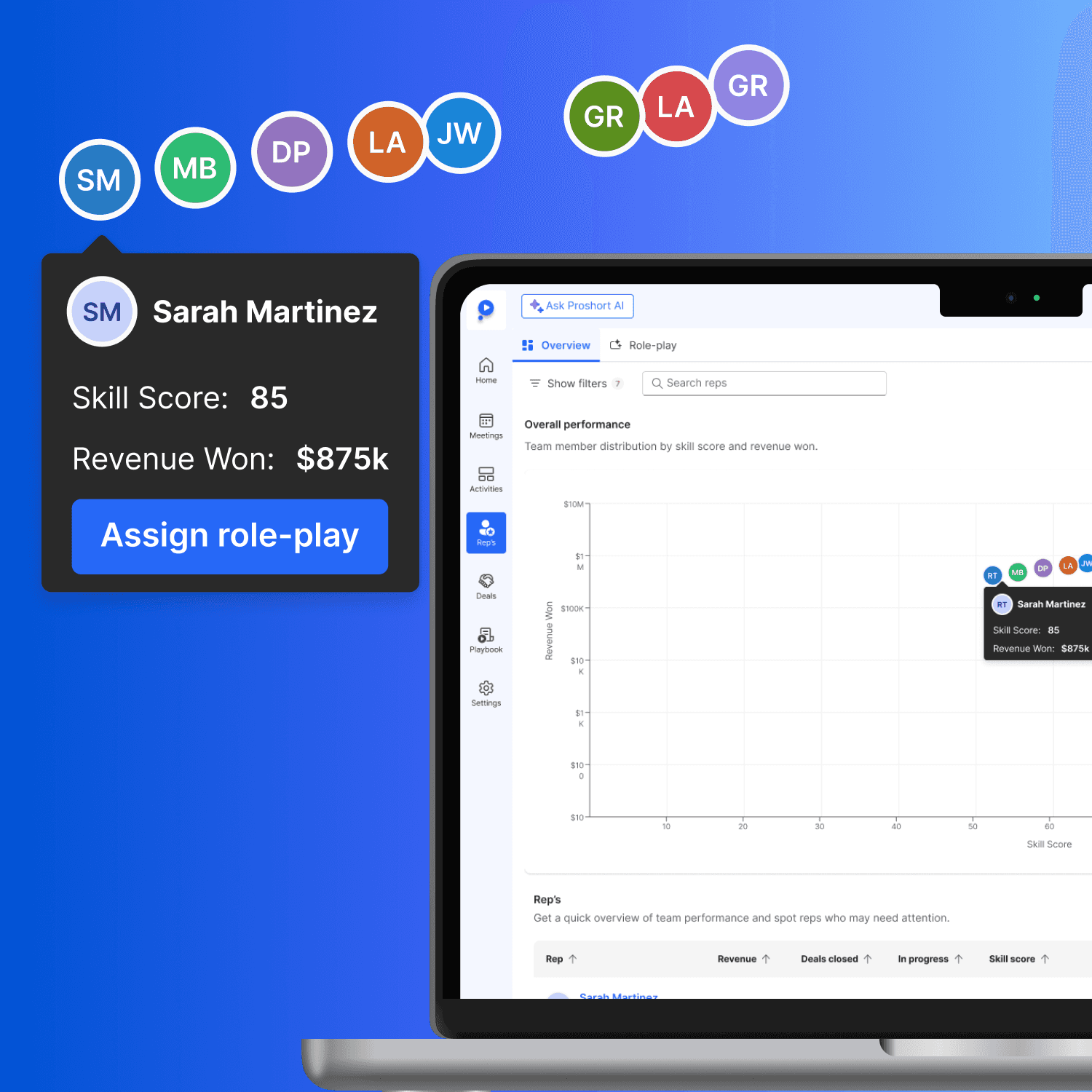
MANAGER OVERVIEW
Scatter plot of skill vs revenue, leaderboard, sentiment signals. Built for pattern recognition at a glance — not data analysis.
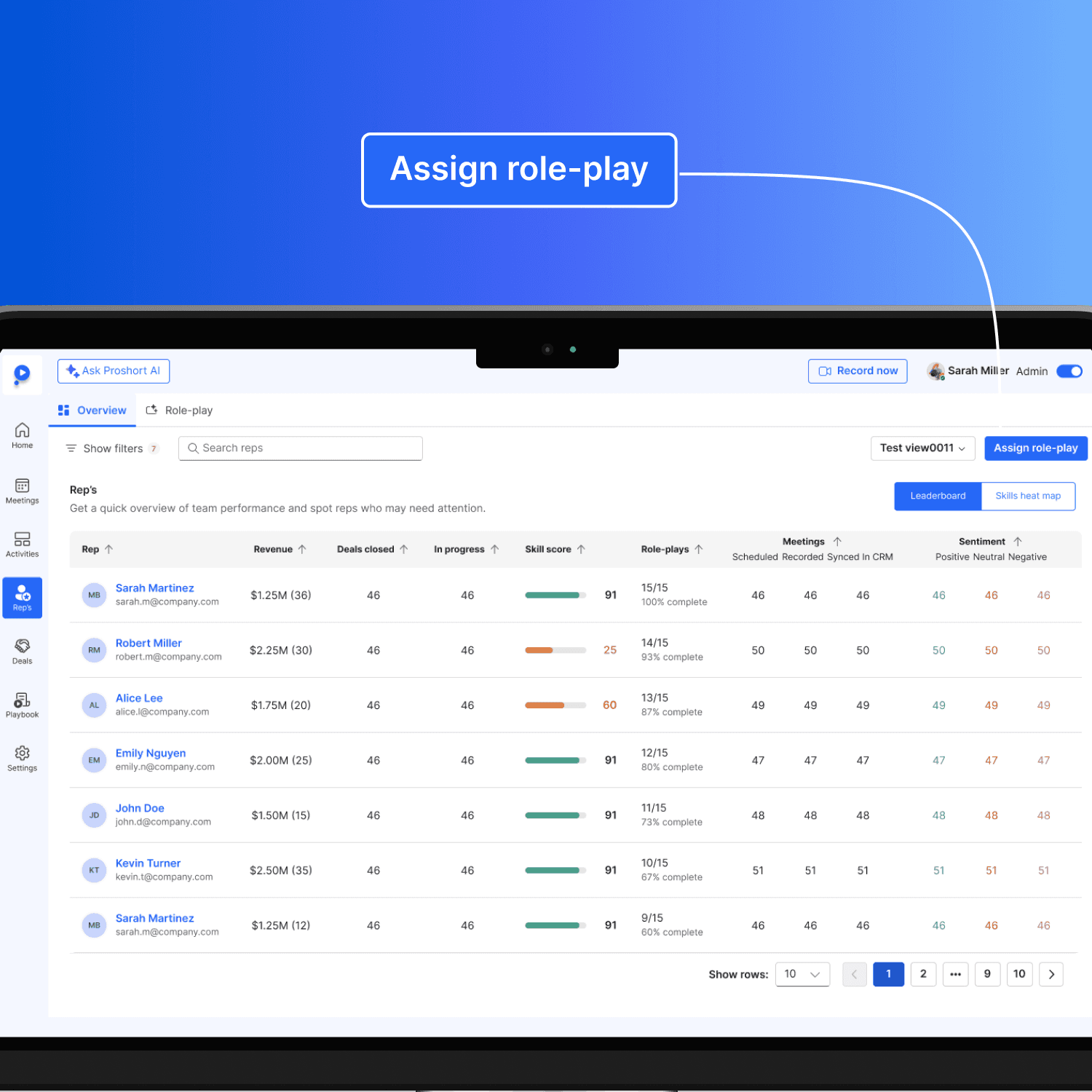
B
REP VIEW
Critical deals, AI key insights, recommended actions, real call highlights. Each rep is a story — not a row.
C
SKILLS DEEP DIVE
Radar for capability snapshot. Trend graph for progress. Real call examples for context. Practice path via roleplay CTA.
D
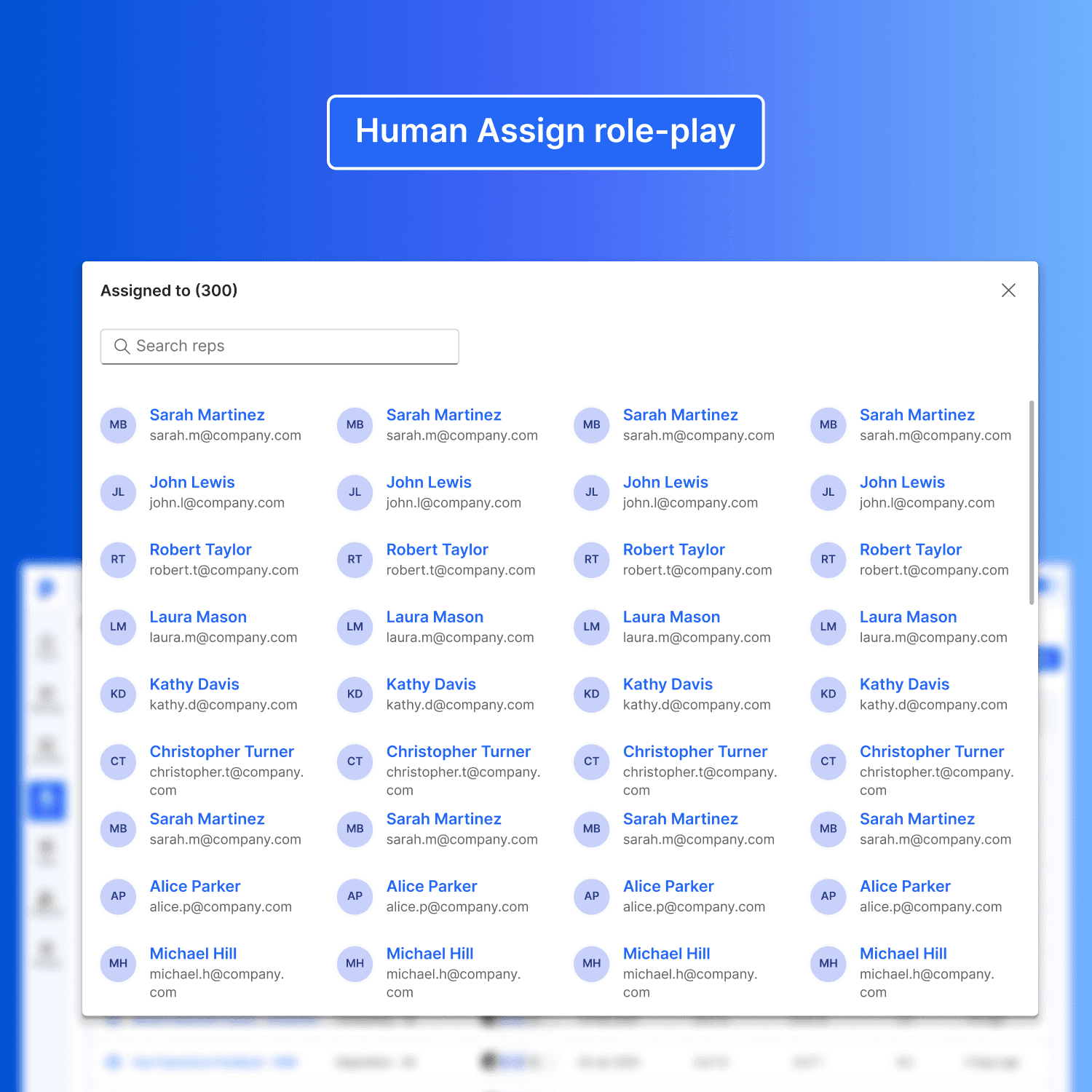
ASSIGN ROLEPLAY
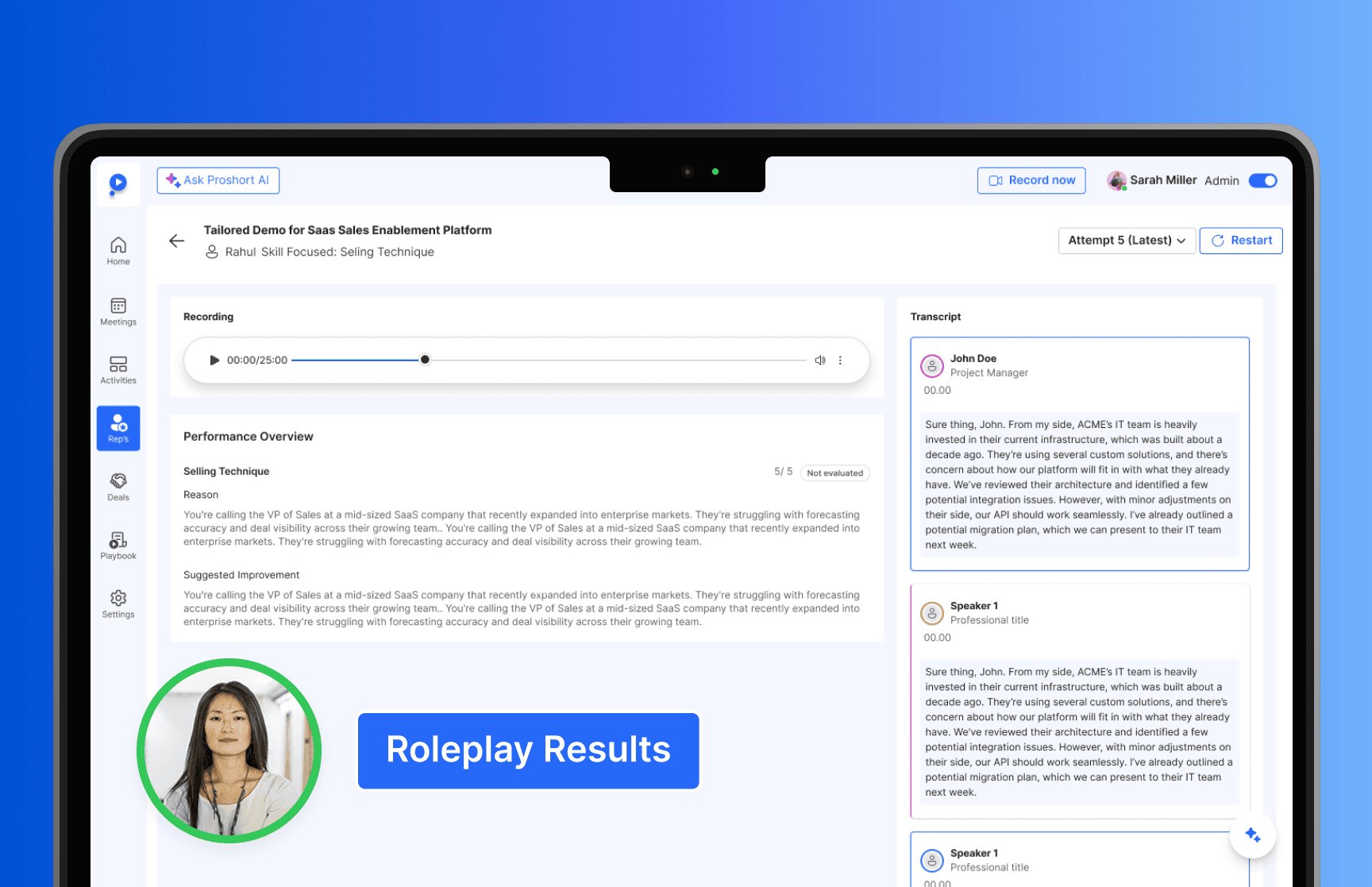
One modal. AI prefills persona, scenario, skill focus. Manager confirms instead of designing. "Don't make managers design training — let AI do it."
06 — REAL USAGE PATTERNS
Managers Don't Follow Flows. They Jump.
Four Entry Paths We Designed For
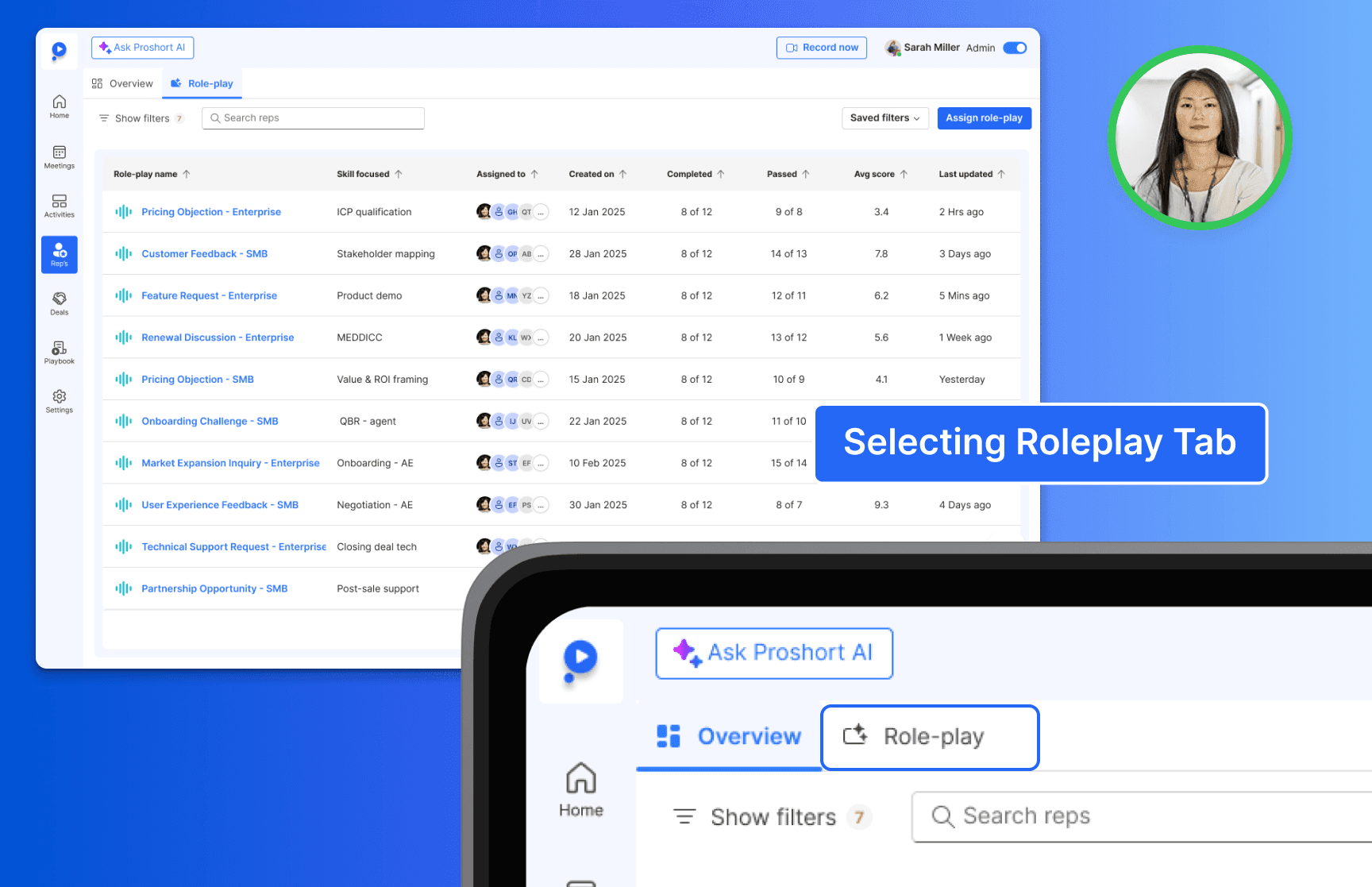
We initially designed a linear funnel: Overview → Rep → Skills → Roleplay. Real behaviour was non-linear — managers entered from notifications, deal alerts, or roleplay metrics depending on what triggered them. So we made every screen a valid entry point to action.
PATH A — TOP-DOWN
Overview → Rep → Skills → Roleplay
PATH B — DEAL-DRIVEN
Deal risk → Rep → Assign roleplay
PATH C — COACHING
Roleplay tab → Assign → Then check rep
PATH D — REACTIVE
Notification → Rep → Quick action

07 — AI AS A SYSTEM LAYER
Behavior Change, Not Just Usage
The Metric That Finance Understood Before UX
Usage rates are easy to fake — click a tab, it counts. These metrics measure whether managers coached differently, whether reps improved, and whether preparation behavior actually shifted.
Increase
in Coaching session
44%
45 min → 12 min/week
Manager 1:1 prep time
−73%
over 6 weeks
Rep call quality score
+22%
Manager 1:1 prep dropping from 45 min to 12 min per rep per week translated directly into manager time recovered — a number finance understood before they understood UX. It became the internal sell for full rollout.
The metric that got the rollout approved
08 — KEY LEARNINGS
What This Taught Me
Four Principles That Survived the Build
01
Insight ≠ Action
A dashboard that shows the right thing but doesn't surface what to do next will be opened, scanned, and ignored. Pair every insight with the closest possible action.
02
Linear flows lie
Real users jump. Notifications, alerts, and curiosity dictate entry points — not your IA diagram. Every screen needs to be a valid starting point for action.
03
AI removes design effort, not control
Full automation killed trust. Pre-filled-with-edit kept it. The job is to remove busywork from the manager — not the decision.
04
This wasn't a dashboard project
It was about designing decision-making behavior. Shifting managers from reviewing performance after failure to actively shaping outcomes before it.
THE EVOLUTION
Why Global Search as a Feature Needed to Change
Product Design
AI Systems
Sales Industry
AI Coaching for Sales Teams
COmpany:
Proshort
Category:
Adapting User flow
My Role:
UX Design and Research
Designing a system that turns performance insights into action — pairing rep diagnostics with contextual AI roleplays so managers stop reviewing failure and start shaping outcomes before they happen.
Platform usage
Issue
Jan-Feb 2026
Timeline
Insight → Action
Impact
01 — THE REAL PROBLEM
Managers Had Data. They Weren't Acting on It.
Decision Latency Was the Real Problem
The ask was "AI assistant for managers." Interviews revealed the real gap was decision latency — managers were discovering rep performance issues 2–4 weeks after they became problems. By then, the coaching window had closed. The brief was wrong. The problem was structural, not informational.
It's not a feature problem. It's a behavioral gap problem.
Rep issues discovered 2–4 weeks too late to intervene
Business problem
Managers guessing who to coach — wasting 1:1 time on wrong reps
User problem
'Coaching' meant visibility to managers, development to reps
Ambiguity
02 — THE WRONG BETS
What We Tried First (And Why It Failed)
Three Concepts, Zero Behavior Change
Two early concepts shipped to a small group of managers. Both technically worked. Neither moved behavior. Documenting them honestly here because the failed attempts taught us more than the final design did.
CONCEPT 1
ADVANCED ANALYTICS
More graphs, more filters, more segmentation. Result: managers looked but didn't act. Insight ≠ action.
CONCEPT 2
AI RECOMMENDATIONS PANEL
Side-panel AI suggestions felt like notifications. Easy to ignore. No urgency, no integration with the work itself.
CONCEPT 3
AUTO-ASSIGNMENT
Fully automated roleplay assignment. Removed manager control. Trust collapsed; assignments got dismissed.
03 — THE BREAKTHROUGH
Insight + Action, In the Same Place
Dashboard-First vs Decision System
We reframed the system. Instead of: "Dashboard → Insight → Manager thinks → Action," we designed: "Situation → Insight → Action — all in the same place." Every screen became a valid entry point to action.
DASHBOARD-FIRST
DASHBOARD-FIRST
Insights live in one place
Insights live in one place
Actions live in another
Actions live in another
Manager has to translate
Manager has to translate
Cognitive load: high
Cognitive load: high
Coaching feels reactive
Coaching feels reactive
DECISION SYSTEM
Insight + action paired
Coaching CTA next to risk signal
Translation already done
Cognitive load: low
Coaching becomes proactive
04 — REP VIEW EVOLUTION
Four Iterations to Get It Right
V1 Through V4 — What Changed Each Time
The Rep View is where most of the design depth happened. Each version solved a problem and surfaced a new one. The iteration story matters more than the final pixel.
V1
Data-heavy rep view
Tables, KPIs, metrics. Hard to scan, no prioritisation, no action triggers. Managers got lost in the data.
V2
Card-based rep view
Scanability up. Visual grouping up. But managers still asked: "What should I do?" Cards organised data, didn't drive decisions.
V3
Insight + action pairing
Each insight paired with a recommended action and a roleplay CTA. This was the breakthrough. Managers started taking actions directly inline.
V4
Contextual rep intelligence — final
Critical deals with risk tags, AI-generated insights, embedded actions, real call highlights. Not a dashboard — a decision surface.
05 — KEY SCREENS
Four Surfaces, One System
What Each Screen Was Built to Do
A
MANAGER OVERVIEW
Scatter plot of skill vs revenue, leaderboard, sentiment signals. Built for pattern recognition at a glance — not data analysis.
B
REP VIEW
Critical deals, AI key insights, recommended actions, real call highlights. Each rep is a story — not a row.
C
SKILLS DEEP DIVE
Radar for capability snapshot. Trend graph for progress. Real call examples for context. Practice path via roleplay CTA.
D
ASSIGN ROLEPLAY
One modal. AI prefills persona, scenario, skill focus. Manager confirms instead of designing. "Don't make managers design training — let AI do it."
06 — REAL USAGE PATTERNS
Managers Don't Follow Flows. They Jump.
Four Entry Paths We Designed For
We initially designed a linear funnel: Overview → Rep → Skills → Roleplay. Real behaviour was non-linear — managers entered from notifications, deal alerts, or roleplay metrics depending on what triggered them. So we made every screen a valid entry point to action.
PATH A — TOP-DOWN
Overview → Rep → Skills → Roleplay
PATH B — DEAL-DRIVEN
Deal risk → Rep → Assign roleplay
PATH C — COACHING
Roleplay tab → Assign → Then check rep
PATH D — REACTIVE
Notification → Rep → Quick action
07 — AI AS A SYSTEM LAYER
Behavior Change, Not Just Usage
The Metric That Finance Understood Before UX
Usage rates are easy to fake — click a tab, it counts. These metrics measure whether managers coached differently, whether reps improved, and whether preparation behavior actually shifted.
Increase
in Coaching session
44%
45 min → 12 min/week
Manager 1:1 prep time
−73%
over 6 weeks
Rep call quality score
+22%
Manager 1:1 prep dropping from 45 min to 12 min per rep per week translated directly into manager time recovered — a number finance understood before they understood UX. It became the internal sell for full rollout.
The metric that got the rollout approved
08 — KEY LEARNINGS
What This Taught Me
Four Principles That Survived the Build
01
Insight ≠ Action
A dashboard that shows the right thing but doesn't surface what to do next will be opened, scanned, and ignored. Pair every insight with the closest possible action.
02
Linear flows lie
Real users jump. Notifications, alerts, and curiosity dictate entry points — not your IA diagram. Every screen needs to be a valid starting point for action.
03
AI removes design effort, not control
Full automation killed trust. Pre-filled-with-edit kept it. The job is to remove busywork from the manager — not the decision.
04
This wasn't a dashboard project
It was about designing decision-making behavior. Shifting managers from reviewing performance after failure to actively shaping outcomes before it.
THE EVOLUTION
Why Global Search as a Feature Needed to Change
Product Design
AI Systems
Sales Industry
AI Coaching for Sales Teams
COmpany:
Proshort
Category:
Adapting User flow
My Role:
UX Design and Research
Designing a system that turns performance insights into action — pairing rep diagnostics with contextual AI roleplays so managers stop reviewing failure and start shaping outcomes before they happen.
Platform usage
Issue
Jan-Feb 2026
Timeline
Insight → Action
Impact
01 — THE REAL PROBLEM
Managers Had Data. They Weren't Acting on It.
Decision Latency Was the Real Problem
The ask was "AI assistant for managers." Interviews revealed the real gap was decision latency — managers were discovering rep performance issues 2–4 weeks after they became problems. By then, the coaching window had closed. The brief was wrong. The problem was structural, not informational.
It's not a feature problem. It's a behavioral gap problem.
Rep issues discovered 2–4 weeks too late to intervene
Business problem
Managers guessing who to coach — wasting 1:1 time on wrong reps
User problem
'Coaching' meant visibility to managers, development to reps
Ambiguity
02 — THE WRONG BETS
What We Tried First (And Why It Failed)
Three Concepts, Zero Behavior Change
Two early concepts shipped to a small group of managers. Both technically worked. Neither moved behavior. Documenting them honestly here because the failed attempts taught us more than the final design did.
CONCEPT 1
ADVANCED ANALYTICS
More graphs, more filters, more segmentation. Result: managers looked but didn't act. Insight ≠ action.
CONCEPT 2
AI RECOMMENDATIONS PANEL
Side-panel AI suggestions felt like notifications. Easy to ignore. No urgency, no integration with the work itself.
CONCEPT 3
AUTO-ASSIGNMENT
Fully automated roleplay assignment. Removed manager control. Trust collapsed; assignments got dismissed.
03 — THE BREAKTHROUGH
Insight + Action, In the Same Place
Dashboard-First vs Decision System
We reframed the system. Instead of: "Dashboard → Insight → Manager thinks → Action," we designed: "Situation → Insight → Action — all in the same place." Every screen became a valid entry point to action.
DASHBOARD-FIRST
DASHBOARD-FIRST
Insights live in one place
Insights live in one place
Actions live in another
Actions live in another
Manager has to translate
Manager has to translate
Cognitive load: high
Cognitive load: high
Coaching feels reactive
Coaching feels reactive
DECISION SYSTEM
Insight + action paired
Coaching CTA next to risk signal
Translation already done
Cognitive load: low
Coaching becomes proactive
04 — REP VIEW EVOLUTION
Four Iterations to Get It Right
V1 Through V4 — What Changed Each Time
The Rep View is where most of the design depth happened. Each version solved a problem and surfaced a new one. The iteration story matters more than the final pixel.
V1
Data-heavy rep view
Tables, KPIs, metrics. Hard to scan, no prioritisation, no action triggers. Managers got lost in the data.
V2
Card-based rep view
Scanability up. Visual grouping up. But managers still asked: "What should I do?" Cards organised data, didn't drive decisions.
V3
Insight + action pairing
Each insight paired with a recommended action and a roleplay CTA. This was the breakthrough. Managers started taking actions directly inline.
V4
Contextual rep intelligence — final
Critical deals with risk tags, AI-generated insights, embedded actions, real call highlights. Not a dashboard — a decision surface.
05 — KEY SCREENS
Four Surfaces, One System
What Each Screen Was Built to Do
A
MANAGER OVERVIEW
Scatter plot of skill vs revenue, leaderboard, sentiment signals. Built for pattern recognition at a glance — not data analysis.
B
REP VIEW
Critical deals, AI key insights, recommended actions, real call highlights. Each rep is a story — not a row.
C
SKILLS DEEP DIVE
Radar for capability snapshot. Trend graph for progress. Real call examples for context. Practice path via roleplay CTA.
D
ASSIGN ROLEPLAY
One modal. AI prefills persona, scenario, skill focus. Manager confirms instead of designing. "Don't make managers design training — let AI do it."
06 — REAL USAGE PATTERNS
Managers Don't Follow Flows. They Jump.
Four Entry Paths We Designed For
We initially designed a linear funnel: Overview → Rep → Skills → Roleplay. Real behaviour was non-linear — managers entered from notifications, deal alerts, or roleplay metrics depending on what triggered them. So we made every screen a valid entry point to action.
PATH A — TOP-DOWN
Overview → Rep → Skills → Roleplay
PATH B — DEAL-DRIVEN
Deal risk → Rep → Assign roleplay
PATH C — COACHING
Roleplay tab → Assign → Then check rep
PATH D — REACTIVE
Notification → Rep → Quick action
07 — AI AS A SYSTEM LAYER
Behavior Change, Not Just Usage
The Metric That Finance Understood Before UX
Usage rates are easy to fake — click a tab, it counts. These metrics measure whether managers coached differently, whether reps improved, and whether preparation behavior actually shifted.
Increase
in Coaching session
44%
45 min → 12 min/week
Manager 1:1 prep time
−73%
over 6 weeks
Rep call quality score
+22%
Manager 1:1 prep dropping from 45 min to 12 min per rep per week translated directly into manager time recovered — a number finance understood before they understood UX. It became the internal sell for full rollout.
The metric that got the rollout approved
08 — KEY LEARNINGS
What This Taught Me
Four Principles That Survived the Build
01
Insight ≠ Action
A dashboard that shows the right thing but doesn't surface what to do next will be opened, scanned, and ignored. Pair every insight with the closest possible action.
02
Linear flows lie
Real users jump. Notifications, alerts, and curiosity dictate entry points — not your IA diagram. Every screen needs to be a valid starting point for action.
03
AI removes design effort, not control
Full automation killed trust. Pre-filled-with-edit kept it. The job is to remove busywork from the manager — not the decision.
04
This wasn't a dashboard project
It was about designing decision-making behavior. Shifting managers from reviewing performance after failure to actively shaping outcomes before it.
THE EVOLUTION
Why Global Search as a Feature Needed to Change